

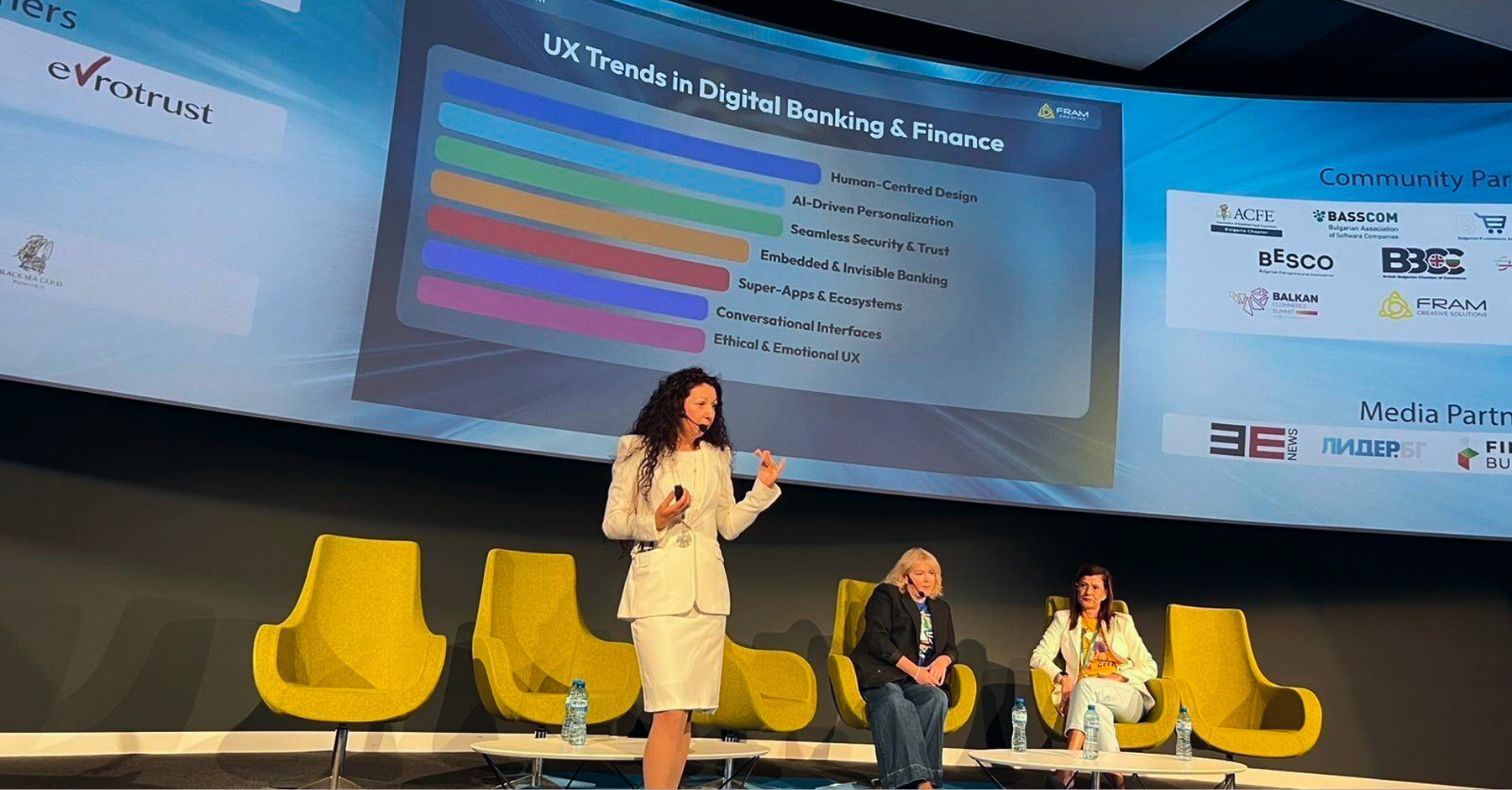

In 2025, banking UX is shifting toward mobile-first design, AI-powered personalization, and emotionally intelligent experiences that reduce friction and build trust. At DIGI PAY 2025, Marina Shideroff—Founder & CEO of FRAM Creative—outlined why banks must evolve beyond legacy patterns and embrace human-centered, adaptive financial design.
Banking UX in 2025 is at a crossroads: user expectations are rising faster than banks can redesign their systems. Customers want intuitive apps, responsive service, and personalized insights, yet many institutions still operate with legacy technology and fragmented digital ecosystems.
Research highlights this shift:
Marina noted that banks talk about innovation confidently, but few deliver experiences that feel genuinely simple, human, and intelligent.
Because users expect technology that clarifies their financial lives, not complicates them.
During her DIGI PAY session, Marina emphasized that the industry is shifting from more tech to smart tech — solutions that reduce cognitive load, guide decisions, and adapt to each user in real time.
This shift is accelerating because expectations are changing faster than banks can modernize. Users want interfaces that feel supportive, intelligent, and personalized — not transactional or static.
Most banks still struggle with mobile usability because their apps prioritize features over clarity.
FRAM Creative’s audits consistently reveal:
The opportunity: redesign mobile experiences around focus, speed, and completion of key tasks — not just feature lists.

Banks that simplify language and reduce compliance friction will win user trust.
Regulatory constraints matter, but clarity matters more. Emotional reassurance must be built into every micro-interaction.
Users don’t need more financial data — they need meaning.
Dashboards should interpret, highlight, and contextualize information so users can act with confidence.
Still underused in banking, even though progress bars, milestones, and nudges increase motivation and financial literacy.
Younger generations expect apps to reflect their values.
Carbon tracking, sustainable investment indicators, and ethical spending insights remain missing in many European markets — a major opportunity for differentiation.
AI turns raw transactions into predictions, nudges, and tailored financial guidance.
Recommendations become contextual, helpful, and proactive.
Voice and chat interfaces reduce friction and make banking more accessible.
They simplify daily tasks and bring banking closer to natural communication.
Next-gen apps anticipate needs instead of waiting for input, e.g.:
Routine approvals, identity checks, and transfers will increasingly run on autopilot.
Layouts and content blocks will change based on user intent, decreasing cognitive load.
UI that senses hesitation or confusion will adjust tone, pace, and support.
As Marina put it: “The future of financial UX will feel alive, not static.”
Because their structures weren’t built for rapid UX evolution.
Common barriers include:
Marina stressed that true transformation requires leadership commitment, unified design systems, and a culture of prototyping and iteration.
Based on large-scale redesigns for institutions like BNB, KBC Group (UBB), Allianz Bank, Municipal Bank, DBank, Sparkasse, and BankenVerband Germany, FRAM consistently identifies the same needs:
Banks that embrace these principles reduce support load, accelerate product development, and significantly increase customer satisfaction.
Design for small screens, short attention spans, and real-life usage — not desktop downsizing.
Every part of the journey should adapt, recommend, predict, and automate.
Not optional — legally required and commercially essential.

Financial decisions are emotional. Interfaces must reassure, guide, and support.
Transparency builds trust; values build loyalty.
Web, mobile, internal tools, and branches must feel like one unified bank.
AI-powered personalization, mobile-first design, predictive experiences, ethical banking, and emotionally intelligent interfaces.
AI enables proactive insights, automation, sentiment-aware interactions, and adaptive design that feels uniquely tailored to each user.
Legacy systems, compliance constraints, siloed teams, and fragmented design processes.
By simplifying flows, reducing clutter, ensuring consistency, and prioritizing the top user tasks.
Meaningful insights, contextual indicators, clear visuals, and guidance—not raw data.
Gen Z and Millennials expect transparency, sustainability, and alignment with personal values.
Through large-scale redesign, AI-ready design systems, multi-market localization, and strategic UX leadership.
Financial UX is entering its most transformative decade. The combination of AI, rising expectations, and new regulatory standards will redefine how people interact with money.
Marina Shideroff’s message at DIGI PAY was clear:
“Banks must stop talking about innovation and start building it — with users at the center and AI as the engine.”
The institutions that act now will capture trust, loyalty, and long-term advantage.
A clearer, more intelligent, more human financial future is within reach — and the work starts now.



Our friendly team would love to hear from you.
By submitting this form you agree with our Privacy Policy

